


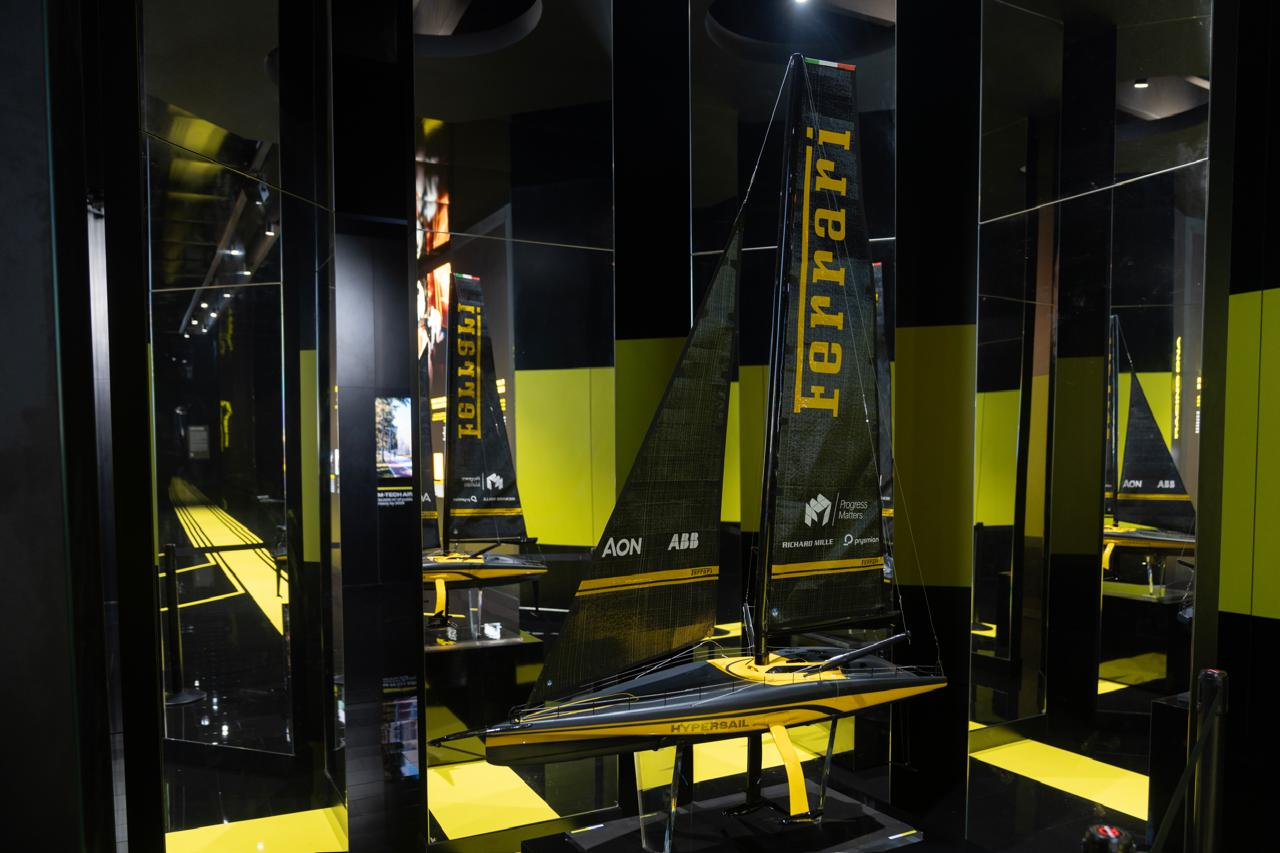
Girish Mallya, Editor, T3 India, speaks with Matteo Lanzavecchia, Chief Technology Officer of the Ferrari Hypersail project and Head of Vehicle Engineering for Ferrari Sports Cars, about the strategic purpose of the programme, technology cross-pollination, energy self-sufficiency and long-term value.
Girish Mallya: From a Ferrari perspective, Hypersail sits outside the company’s core automotive business. How do you view the project strategically? Is it primarily an internal initiative to challenge the team, develop talent and generate learnings that can feed back into the cars, or is there a broader commercial intent?
Matteo Lanzavecchia: We strongly believe that the cross-pollination of different worlds is essential for innovation. I hold two roles simultaneously, CTO of Hypersail and Head of Vehicle Engineering for the sports cars, precisely to ensure continuous technology transfer in both directions.
Hypersail functions as a technological laboratory. People from Ferrari’s competitive environment are involved so they think more broadly by engaging with a completely different domain. We are convinced we can bring value to sailing, and equally confident that value will flow back to our primary business. Early examples already exist in control systems and energy management.
Girish Mallya: You mentioned control systems. Can you elaborate on the transfer from the cars to the boat?
Matteo Lanzavecchia: I joined Ferrari in 2003. At that time the cars essentially had ABS; today a Ferrari has more than 40 active control systems. We spent years developing methodologies that keep the driver engaged and confident while extracting maximum performance from very powerful vehicles.
We applied the same approach to Hypersail’s flight control. The sailor defines the route and target ride height, while the platform is managed by our control system to optimise aerodynamics, minimise drag and manage energy. The underlying principles of energy efficiency and vehicle dynamics are remarkably similar even though the environments differ. The same people who develop these systems for the cars are working on the boat.
Girish Mallya: Another example you have highlighted is the “Winch by Wire” system. How does that work, and what does it demonstrate?
Matteo Lanzavecchia: Traditional winches rely on a direct mechanical connection between the grinder and the load. We replaced that with electric motors and cables, essentially removing the mechanical link. Crew input is converted into electricity, centralised and redistributed wherever it is needed. This improves efficiency, packaging and layout.
We developed it in parallel with “by-wire” thinking on the cars. Our initial concern was that the sailor would lose the tactile feel of a traditional system. That proved unfounded: you can retain the same sensation while gaining significant advantages, including the ability to manage loads more effectively and automatically. It is analogous to the debate around electric vehicles versus internal-combustion engines — new technology can preserve and even enhance the essential character of the experience rather than diminish it.
The same philosophy allowed us to create vehicles that would have been impossible with a conventional powertrain architecture, while still delivering Ferrari DNA. New technology is used to strengthen, not dilute, that DNA.
Girish Mallya: How does Ferrari approach the return on investment for Hypersail? Is licensing intellectual property an option? Could components or systems be commercialised for the broader yacht industry?
Matteo Lanzavecchia: At present Ferrari is investing in innovation, and Hypersail is a major innovation project. Our first priority is to demonstrate that these technologies work. Ideas such as Winch by Wire, or the fact that all energy used on board is generated on board, making the boat self-sufficient through solar panels, wind turbines and kinetic recovery, need to be proven at sea.
If we succeed, certain solutions could certainly be relevant to other boats. But the immediate focus is validating the energy balance: that the energy we can harvest matches what we need to sail. Monetisation or wider application is a later consideration.
Girish Mallya: The self-sufficient energy concept sounds environmentally attractive. Is sustainability, including materials and end-of-life considerations, part of the scope?
Matteo Lanzavecchia: The primary goal has been a very high-performance sailing boat. Self-sufficiency is central to that performance objective, eliminating the need for a diesel generator while sailing. We are concentrating on proving the energy systems first. Materials, recycling and broader carbon-neutral considerations can follow as a second step. There are still many technical challenges to resolve.
Girish Mallya: What is the next phase of the project?
Matteo Lanzavecchia: Everyone is focused on the boat itself. We expect to finish painting and assembly by the end of the year, then move it to our base on the Mediterranean coast. Testing will begin next year, initially in the Mediterranean, before we head out to race.
We have a four-to-five-year outline of the records and regattas we would like to target. Right now the priority is simply to prove the technology works. As we gather real-world data and see how the boat performs, we will refine the plan further.







Leave a Reply